
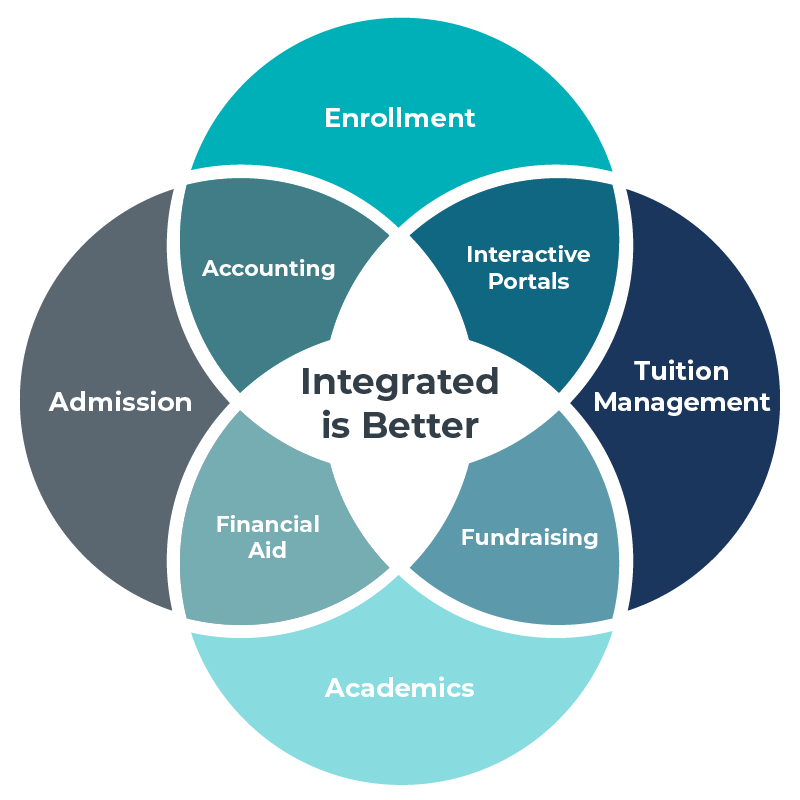

We’ve heard it from school heads for years: “We are a mess” (speaking of databases, that is). “We are a mess. And we want one integrated system, that’s what’s going to solve our problems.”
Well, it depends upon what your definition of “integrated” is.
Searching for a harmonious, integrated system is natural. We humans seek ease and power in our lives and our work. The ultimate success would be for each segment of a school to work fluidly together, as one.
At iR we agree with this goal. But we don’t agree that a “total solution” is the answer. We see integration as synergy: efficient, appropriate systems, each serving a targeted need, linked harmoniously through technological and human systems.
Consider for a moment that not even the most brilliant high-tech companies in the world, with gigantic budgets and vast internal resources—not even those companies have integrated all their systems into one. Independent schools don’t have gigantic budgets or vast internal resources. Why, then, the expectation that your school could do what these giants could not?

Independent schools are doing the impossible all the time. Ratcheting up your services while tightening your belts. You’re independent by definition. Why NOT integrate everything into one total system?
We suggest this radical idea: because it may not be your best option.
It’s a cost/benefit thing. Time and treasure are hard to come by: make your investments where they will have the most enduring impact. Make budgets realistic, predictable. Increase productivity. Allocate resources toward the mission.
Once every five years or so, schools get on the new technology bandwagon: “Let’s do it right,” says the Head. Surveys are distributed: what would your ideal system do? A task force is created. The industry leaders are called in. Dogs and ponies show up. Meetings have meetings.
Think twice before you get onto the “total school integration” ferris wheel. Then think again. What are the real costs? What really needs fixing? Will changing the tools make each individual office better able to meet its goals? Too often, perfectly functioning offices are asked to convert to something far less powerful in order to "be a team player."
Listen carefully. Promises, promises about administrative databases are compelling: you can get modularity, functionality, universality, total integration...
What’s a school to do about evaluating sales claims and arriving at the right selection? Which services and tools will increase your enrollment and annual fund and reduce attrition? What makes a family feel connected and loyal?
Think about the human body. We don’t expect the heart to do our breathing for us. We ourselves are beautifully integrated: separate, efficient systems which, working together, multiply our complexity and power. Yet it works like one easy system.
That’s what you need: the best system for each job. And a connective process to make sure your information flows appropriately from one system to the next.
What integration is essential?
iR has worked with more than 200 schools around the world over the last decade. We’ve worked in independent schools, done your jobs. We understand best practices. We have opinions. Such as:
1. Don’t try to change the whole school when all you may need is a better solution in one or two offices.
2. Create powerful, effective, separate offices and give them the tools they request that best serve their needs.
3. Be clear about what does need to be integrated (most common, most time-consuming, most often required tasks), and invest your time and money there. Be on the lookout for false economies. iR believes the essential points for integration are:
- Registrar / student information system must integrate with

Realistic IntegrationiR offers a network of interconnected support resources to help your school gain appropriate independence. Our clients range from those who use the solutions right out-of-the-box, to those long-time customizing clients whose solutions have been so individualized that they are no longer iR’s, they are unique to those schools.
The support network is integrated, too. iR clients rely upon our own internal support team, outside FileMaker developers, and each other to build what they need to do their work, their way.
Schools are too complex as organizations to simply slip on a generic integrated web/data solution like a new pair of shoes. There are over 10 database companies and several web companies that all offer excellent, separate-office choices. Schools are different from one another, and have different needs. We believe you’ll find that mixing and coordinating two or three of those choices is the better path.